What does Google and Facebook really know about us?

Personal information refers to ‘information or an opinion about an identified individual, or an individual who is reasonable identifiable’. Personal information and privacy can be a major ethical issue online.If you don’t protect yourself, your data is being collected as soon as you open your web browser. Digital footprints are being left behind, all your activities are tracked so websites can recognise who you are, and this is just the beginning…

How much of this personal information is actually out there, and how much do these major digital companies know about us? This may be an alarming question for most of us. But taking a look at the graph below, a lot of us, especially younger generations are actually pretty comfortable with our information being recorded and used online.

Image Source

ProResource outlines three main reasons why younger generations worry less about online privacy. Firstly, younger generations have grown accustomed to trading data for innovation. People want to be apart of the emerging technologies, and it’s so easy to do so. Secondly, the younger generations believe that they don’t have anything to do lose, or believe that companies ‘don’t want their data’, therefore they don’t think twice about it. Lastly, they care more about the app than their data. They will hastily accept permissions to access contacts, location etc.

Image result for data animation
Image Source

Although there are some dangers and privacy concerns to your information being stored online, there are also some harmless benefits to us consumers. Cookies on the internet tailor what appears on our screen based on previous interactions with the site or application. They help save time, and memorise what we have already seen. For example, cookies are used for online shopping. Online stores often use cookies that record any personal information you enter, as well as any items in your electronic shopping cart, so that you don’t need to re-enter this information each time you visit the site. This is to ensure your next visit is seamless and fast. How handy is that?

Image result for cookies on the internet
Image Source

These types of cookies do not give the site access to any personal information other than that information which you have entered. However, there are malicious cookies out there that track all that you do online. These cookies are used to over time to build a profile of you, and these are the ones to look out for. The question still remains, what do these major digital companies really know about us? Moreover, our personal information seems to be invaded with all these advances in technology, and can be a massive breach of our data in some instances. These digital companies can get almost any sort of our information these days. So the real question is, who actually owns our data? Is it us the consumer, or these large digital companies?

The key to achieving a successful integrated marketing campaign in today’s day and age.

It seems ancient history when the only source of media would be traditional channels such as print media, TV and radio. Now, it’s almost impossible to imagine our lives without the digital technology we have become accustomed to over the past decade. Digital technology has changed the game for marketers, we are able to reach and interact with out audience like never before.

Image result for viral marketing
Image Source

Digital ad spend in Australia has increased over the past few years as displayed in the graph below. More and more businesses are using these digital platforms to market, engage and interact with their consumers. However so many businesses seem to be doing this wrong, and heres why…

Image Source

Kaplan & Haenlein‘s table describes the four groups of social media viral marketing campaigns. Strokes of luck refer to positive outcomes initiated by consumers. Remember the mentos and coke experiment? This experiment got so popular online, it received over 12.5 million views on YouTube and got invited to perform the experiment on live television. Triumphs refer to positive outcomes initiated by companies. For example, Burger King’s Whopper Sacrifice campaign which generated over 20,000 free whopper coupons by sacrificing 233,906 Facebook friends altogether. Nightmares refer to negative outcomes initiated by customers, such as the case if JetBlue. One of JetBlue’s flights were delayed due to an ice-storm, which caused thousands of flights of flights to be cancelled and delayed. Customers were outraged and an abundance of negative comments were generated. Lastly, Homemade issues refers to negative outcomes initiated by companies. This occurred in Charlie’s and Jeremy’s Sony PSP Blog, when Sony created a fake blog to convince parent’s to buy PSP’s for their children. Sony faced furious comments from customers. Viral marketing is a vital part of digital marketing and getting it right can lead to huge brand success, but if not, it can have the opposite effect.

So how do we ensure we get this right? Jennifer Lonoff Schiff explains the 7 steps to create a successful integrated marketing campaign:

  1. Have a clear understanding of who your target audience is.
  2. Pick your channels.
  3. Have a consistent look.
  4. Create clear, consistent content that can easily be adapted or repurposed to suit different media or channels.
  5. Ensure that your messaging is integrated.
  6. Make sure your marketing teams/agencies are working in sync.
  7. Don’t forget to track your campaigns — and coupons

Dove’s ‘Campaign for Real Beauty’ does this exceptionally well. By asking the audience the questions of whether they thought the models presented were ‘fat or fit?’ or ‘wrinkled or wonderful?’, it meant that consumers could interact and share the message of Dove’s campaign. It was shared all over social media and was on the way for it to go viral. As a result, Dove had a massive increase if sales for over $1.5bn. Not only was the campaign a huge financial success but customers enjoyed this content as it was ‘groundbreaking, insightful and authentic’.

The rise of the trend has emerged through the use of digital technology for both positive and negative outcomes. One of the most important things is to carefully plan out your campaign in regards to the message being sent out and knowing who it is targeted towards. The last thing you want is for your campaign to go opposite lengths and receive negative outcomes such as the examples above. Viral marketing campaigns are important now, but what about the future? Do you believe the virality trend will ever die or be replaced?

How consumer searches can be optimised through Search Engine Optimisation (SEO)

According to Google, Search Engine Optimisation (SEO) is the process of maximising the number of visitors to a particular website by ensuring that the site appears high on the list of results returned by a search engine. Paid Search Marketing (PPC) refers to the pay-per-click model, where advertisers pay only when people click their ad and visit their website.

As for small businesses, having your website optimised for more views is vital for success. Search Engine Marketing (SEM) is about making your website more visible to people who are searching keywords associated with your product or service via search engines like Google. However, when we are searching on our mobile devices, the first few links that pop up are Pay-Per-Click (PPC) ads. Shown in the example of Googling laptops, the websites displayed at the top are usually PPC ads, SEM ads are found further down the page. Especially when this is displayed on a mobile phone, this can become a problem as people are too lazy to keep scrolling, and will end up only looking at the ads that appear at the top.

For small businesses, it can be difficult to afford the PPC search engine method. These businesses may want to focus on SEO, however there are a number of elements required which are vital in order to successfully boost website visibility.

Image result for seo
Image Source

SEO has changed overtime drastically. In some aspects, SEO is dying. These aspects include; link spamming which builds thousands of back links to a site; link networks which back links networks to sites; content spinning which takes exciting content and uses a software spin to change the words to make it look unique; and press release spam which submits press releases with every blog. Now, SEO has changed and is all about creating good quality content and value. Rand Fishkin created “Mozlow’s hierarchy of SEO needs”, which explains all the fundamental needs for successful SEM.

A pyramid hierarchy of SEO needs based on Maslow's theory of psychology.
Image Source

The above pyramid displays the essential characteristics needed to increase rankings. The higher the pyramid goes, the more likely these characteristics will improve competitiveness with the essentials being at the base. As shown above, SEO is now about creating good quality content, driving social media channels, providing customer value, optimising mobile interface and ensuring back link quality, as it is no longer about quantity. Through satisfying these ‘needs’ shown in the hierarchy, brand awareness can be created and therefore more consumer attention can be attained on your website.

The method is designed to lead to the improvement of unpaid results. This can be the solution to increasing brand-website recognition online and a way to increase value to your consumers. As a user of Google, do you agree that if more businesses used this method, it would encourage you to use these websites?

Is there an ethical dilemma in the Internet of Things?

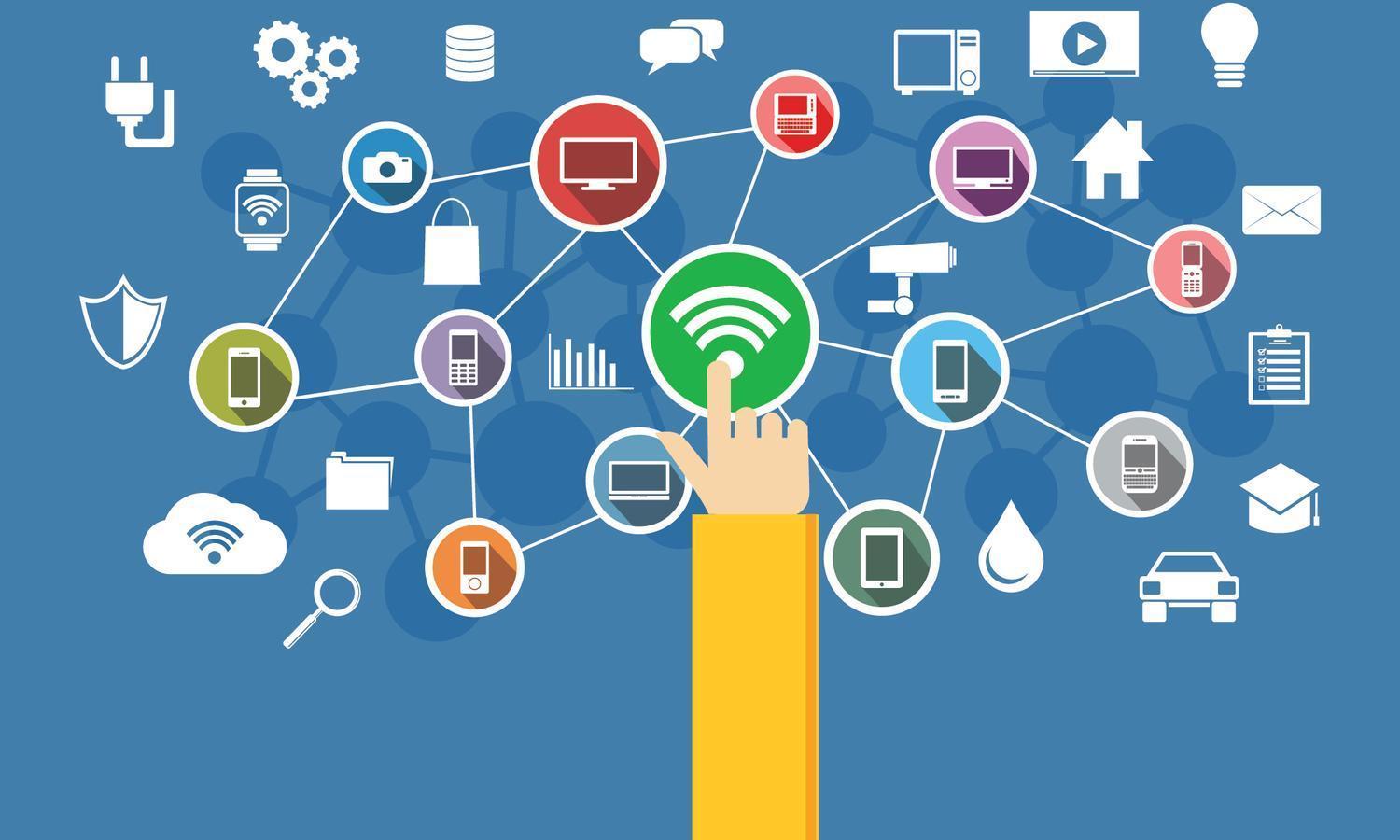
The internet of things (IoT) refers to the billions of physical devices around the world that are now connected to the internet, collecting and sharing data. These new innovations are great, as they allow businesses to gain access to more data, allowing a greater ability to continuously make changes. As for us consumers, it allows us to connect with each other and make our environments smarter and more engaging than ever before through smart home devices. These include Google Home, Amazon’s Echo and even home security systems. It was stated that there are now over 57.8 million smart-speaker users in the US.

However, as these innovations may be exciting, they can have major personal privacy implications.

Image result for internet of things
Image Source

In May 2018, there was a rumour about Amazon Alexa apparently eavesdropping a private conversation of Echo device owner Lily Newman. Newman had claimed that the conversation had been sent to a saved contact, and “the report instantly sparked concern and outrage that Amazon’s Echo smart speaker is listening to and recording much more than the company claims”. Since this incident, it has been proven that at the during this conversation a word extremely similar to ‘Alexa’ and the words ‘send message’ would have triggered this request in order to send the message to the recipient. The situation was all coincidentally all a major mishap.

Amazon was not liable for any privacy breach because they did not violate any of their preset policies or regulations, available to the public in the Code of Business Conduct and Ethics. However, even though not all companies harvest your data, some do. According to Ben Hillard, combining IoT with other data, an accurate and detailed picture of yourself can be created. He determined what colleague Bharat Bedi ate for dinner simply by analysing his home’s energy consumption, carbon monoxide and carbon dioxide levels, temperature, and humidity throughout the day. The data collected by these devices is apart of your privacy, and it some cases this may be breached.

Related image
Animation source

Even though the Internet of Things now has more implications than ever before, overall, I believe consumers of smart home devices or devices of a similar nature should be aware of these possible issues, but understand that most companies do to intend to breach consumers privacy. Companies such as Amazon are transparent about their consumer data usage; it is not there for them to sell, more-so to use themselves to target their advertising and shopping recommendations. As consumers of the IoT, do you think we all need to be more cautious of our privacy?

Is mobile marketing causing traditional marketing to slowly die off?

How many of you own a mobile device? Almost every one of you reading this blog would own a mobile phone or a smartphone. In fact, 5 billion people in the world currently own a mobile device, and more than half of these people own a smartphone. These days, our whole lives are basically stored into these devices, that it is almost impossible to imagine our lives without them.

Image result for digital marketing
Image Source

Coming from the Generation Z category, or the ‘Net Generation’ myself, growing up with smartphones has lead to us to being surrounded by our personal mobile devices most of the time. We hardly ever read the newspaper, watch regular TV or pay attention to billboards or the radio. Its becoming increasingly hard to send messages across to us through traditional channels. Most of us nowadays find ourselves scrolling through our social media apps on our mobile devices, and without even realising, we are being communicated messages from brands across all these relevant channels. Technology is growing and is allowing businesses to connect to their audience like never before.

As of today, 60% of marketers have already switched over their efforts towards digital marketing. The spend on digital ads has increased to $209 billion worldwide (41% of the market), whereas TV ads have reached only 35% of the market. Furthermore, digital ad spend is expected to reach 50% of the market by 2020.

Kaplan highlights the four different social media applications; quick-timers which refers to transferring applications to increase immediacy; space-timers which refers to exchanging messages to location based applications at one point in time; slow-timers which refers to transferring tradiotnal social media to mobile devices and space-locators which refers to exchanging messages in relevance to location read by others. A business which is doing this exceptionally well is Starbucks, which has mobilised the brands consumer experience and marketing strategy. Due to these constant increases in digital mobile marketing, is the future of traditional marketing slowly dying down?

digital marketing vs traditional marketing
Image Source

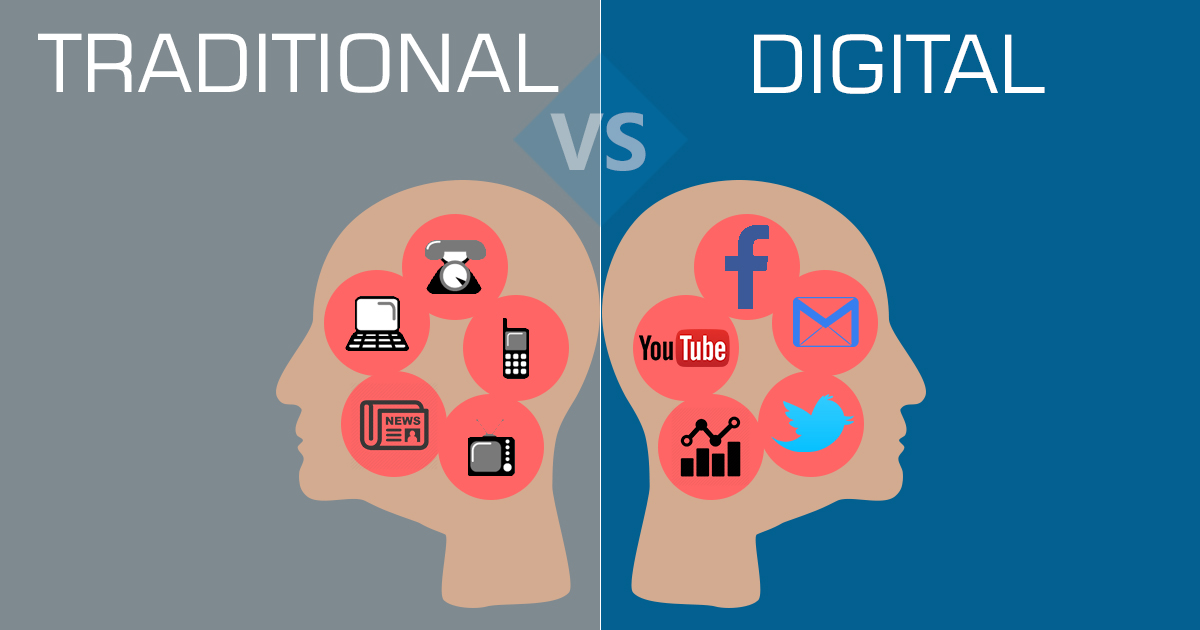
Even though mobile marketing is continuously growing, this does not necessarily mean traditional marketing is going to be completely cut off. Traditional marketing can still be a useful channel for marketers. People still watch TV, read the newspaper and listen to the radio. Instead of killing it, merging it together is an effective way to create more value from these marketing channels. There are numerous ways to do this, for example promoting your online channels through traditional methods.

Just because the digital marketing industry is evolving, it does not necessarily mean traditional methods are dying. By incorporating these channels together, it becomes an effective way to get your message out an interact with your target audience. Do you believe the traditional marketing industry is still important even though the digital marketing industry is continuously evolving?

Why do ideas spread? A guide to achieving marketing virality.

Have you ever wondered why content on the internet goes viral, even if it seems totally irrelevant on some level? Or have you wondered why your phenomenal ideas are struggling to gain a higher audience reach? There may be a simple suggestion uncovered down below.

First off, do you remember in 2015 when Natalie Amyot’s featured video ‘fooled the media’ when it was posted on YouTube? It explained that she fell in love with a man, spent the night with and flew home to Paris the next day, lost his number and found out 6 weeks later she was pregnant. This video went viral, it had over 3 million YouTube views, made it on Channel Seven’s Sunrise, The Project and even Fox news. Soon after, it was revealed that it was all a marketing stunt

Image result for social media girl cartoon
Image Source

You may wonder, what caused this video to go viral? And if the proposed method can be used as a future marketing tool for your business going forward.Jonah Berger’s 6 STEPPS for success suggests a quick-fix to your problem.

  1. Social Currency: This step relates to the fact that shareable information makes us look good. Like the example above, it was a topic of interest which made the information shareable on many platforms, and made the creator ‘look good’ in the eyes of the consumers.
  2. Triggers: This relates to information being easy to remember, ensuring it stays top of mind. The video example above was entertaining, short and simple. This made it easy to remember, therefore easier to share.
  3. Emotion: The third step describes that messages with emotional content is more likely to be shared. Amyot described her experience with emotional components attached such as pregnancy and love. Using emotive experiences is more likely to create the buzz around the topic.
  4. Public: This step details that to creator is to be sure that your content is ‘built to show’. Formatting content is important to showcase that it is meant for sharing, such as a public YouTube video.
  5. Practical value: This describes that if content isn’t relevant, why would it go viral? The example above provides interesting or random content that may be of interest to some consumers, therefore sharing and discussions around the video were created.
  6. Stories: The final step presents that good stories get passed along. Stories keep your content fresh, the audience engaged and gets people talking. This can be explored in the video example as a ‘story’ method was used, and was found to be successful.

Using these 6 STEPPS as a guideline to achieve marketing virality might just be the secret you’re looking for. It can help create curiosity, excitement and ultimately demand around the product, service or idea. It’s one of the fastest ways to market an idea as people are encouraged to pass on the content to other people, building itself by word-of-mouth. Ultimately, it’s about producing content that relates to your audience and drives them to share it.

Could this digital marketing strategy start to arise as a trend once again, and do you think it proves itself as a successful strategy?

Social media advertising may be steering away your customers.

It’s a typical Sunday evening, you’re scrolling through social media apps such as Facebook, Instagram etc., but it seems like you can’t escape being bombarded with advertisements and sponsored content from different brands. ‘How annoying?’ you think to yourself, ‘if only there were a way to choose which brand’s posts I see’…

Majority of social media consumers are irritated by these marketing methods most companies and businesses employ. In fact, the Yellow Social Media Report shows that 53% of social media users ignore sponsored ads, and only 23% are actually happy about seeing this content on social networking sites. Companies need to change their strategies because it’s ultimately driving consumers away.

Related image
Image source

How can we move away from these types of marketing strategies? It’s quite simple. Creating an engaging brand-consumer space where thoughts, opinions, interactions and content are created and shared can add much better value to it’s customers. Hodis et al. (2015) suggests a theory that describes four types of consumer segments; attention seekers, devotees, connection seekers and entertainment chasers. By creating a brand community such as a Facebook group that incorporates all segments, businesses will essentially create better customer value. Through escaping the ‘annoying’ sponsored ads seen on social media platforms, this community allows customers of the opportunity to choose seeing brand-related content if they wish to. Not only does the community provide promotional content, but also engaging and interactive consumer-created content, social brand-events, contests, rewards, discussions and more. Shortstack also suggests that consumers generally find these strategies more relevant and engaging. As encouragement of user-generated content and more personalised interactions are enabled, this further allows consumers to feel a sense of belonging and importance within the group.

Conclusively, sponsored ads are no longer valuable to the majority of social media users, and community-like pages should be created in order to keep customers interested and involved. This ultimately leads to increased brand awareness, a positive word of mouth, and greater consumer value. Customers will no longer want to steer clear from brands adopting these strategies.

Social media: a business bandwagon to consider before jumping on.

As we know, social media is an uprising trend in today’s day and age that allows users to interact with each other through sharing and creating content. With the extents of it’s growth over the last decade, I like to think of it as the heart of the internet. It’s particularly growing in company-related content, where businesses use social media tools as an opportunity to promote their brand. It’s easy to interact with customers, promote products and services and gain a following which ultimately leads to more exposure and customer traffic. Using the example of Red Bull’s ‘Summer Edition’ marketing campaign in 2015, the brands results soared through the roof. According to Digital Marketing Institute (2019) the brand used Instagram to create the hashtag #thissummer, and content relating to typical summer days to get audiences focused on their new can designs. From this, 1.2 million customers were reached, and received a 9-point lift in favourability.

Image result for social media

There have been many examples of social media marketing resulting in customer traffic gains and more personalised interactions. However, does social media always provide the perfect marketing solution?

Involving social media into a companies marketing strategy has many implications, and unfortunately many large brands cop the unfavourable social media backlash. Today, comments and publicity on social media are less controllable by the company than they once were, which may result in serious fallouts. Take Samsung for example, back in 2016 with the Note7 battery explosions. Carlon (2016) mentions that the company was faced with its biggest brand crisis, and suffered a loss of $17 billion dollars in sales revenue. At the time, Samsung was painted in a dark light over the internet, and was mocked over social media causing sales to decline by 15% that year. Kaplan & Haenlein (2009) states that historically, companies were able to have some control of the available information on the company through press announcements and public relations managers. Sadly, this is only one of the many examples of the implications that are now involved with social media marketing.

Although social media ramifications and mishaps can occur to even some of the biggest brands we know, it generally pays off as an insightful business tool to utilise. It’s a genius and revolutionary way to create exposure, build a brand image and increase customer value. I’d jump on the bandwagon if you haven’t already!

References:

Carlon, K. (2016) ‘Samsung permanently discontinues the Galaxy Note 7, $17 billion in sales lost’ ‘Android Authority’. available at: https://www.androidauthority.com/samsung-galaxy-note-7-permanently-discontinued-721283/

Digital Marketing Institute (2019) ‘5 Successful Social Media Campaigns You Can Learn From’ ‘Digital Marketing Institute’. available at: https://digitalmarketinginstitute.com/en-au/blog/5-successful-social-media-campaigns-you-can-learn-from

Kaplan, A.M, Haenlein, M. (2009) ”Users of the world, unite! The challenges and opportunities of Social Media’ ‘ScienceDirect’. Available at: http://www.sciencedirect.com